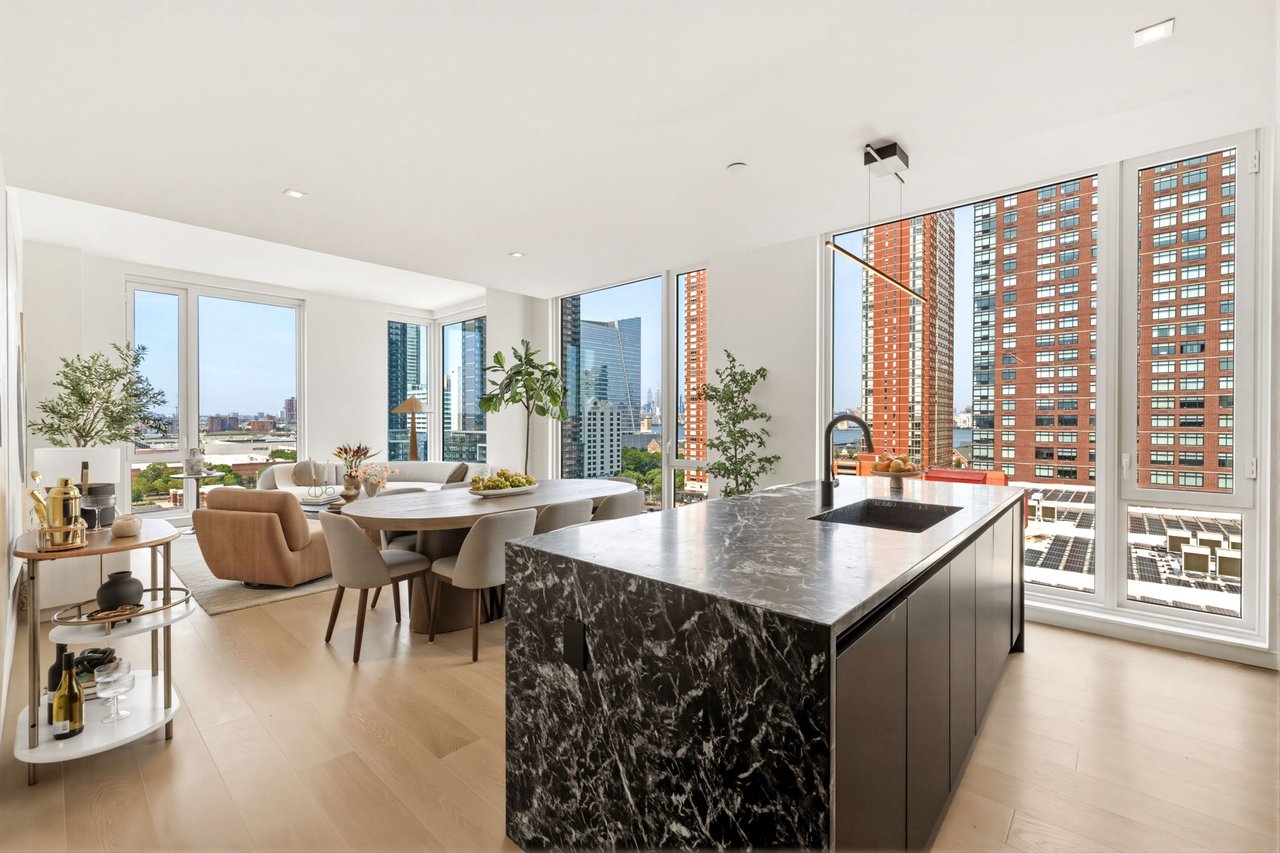
Pricing a Jersey City condo is a disciplined narrowing process, not a single lookup. You move from a citywide figure down to your submarket, your building, your line, and finally your specific unit and its carrying costs, then convert that range into a launch price built for today's balanced market.
The short version, how to price a Jersey City condo:
Start from your submarket benchmark, not the citywide median.
Discard online estimates and citywide price-per-square-foot as pricing tools.
Build a comp analysis from your own line and building outward.
Adjust for floor, view, parking, and outdoor space.
Reconcile HOA fees and PILOT abatement status.
Set a launch price for current absorption conditions.
Your market value and your launch price are related, but they are not the same number.
Market value is what comparable sales say your unit is worth.
Your launch price is the go-to-market decision: the figure you actually list at to sell with momentum instead of stagnating.
Here we will explain that second number.
Where Jersey City Condo Prices Stand, by Submarket
Start with your submarket, because the citywide number blends fundamentally different products. A single median folds a Bergen-Lafayette walk-up and a Waterfront tower unit into one figure that describes neither.
Sources: Brown Harris Stevens, Prodigy, Know This Property, Rocket Homes.
The Downtown-to-Journal-Square gap alone is $374,000, an 84% spread. Separate listing-side from closed-sale figures, too. Realtor.com showed a $749,999 listing median; Redfin recorded a $720,000 closed median. Asking prices tell you what sellers hope for. Only closed prices belong in your pricing work.
Why Online Estimates Mislead Condo Sellers
Treat a Zestimate as a directional starting point, never a pricing authority. Zillow's own accuracy page reports a 7.06% median error for off-market homes; Redfin reports a similar 7.38% to 7.72% range.
Here's what that means in your own dollars. On a $700,000 unit, a 7.06% median error works out to roughly $49,420 in either direction, and that's the midpoint, not the worst case. Half of estimates land further off than that.
Accuracy collapses in dense markets. In New York City, the closest comparable, Zestimates land within 5% only about a third of the time for off-market homes, versus two-thirds nationally. The reason is structural: an automated model cannot see your floor level, your exposure, your line within the building, your renovation quality, or your HOA structure. Zillow itself admits the Zestimate cannot replace an appraisal. A blended $574 citywide price-per-square-foot figure carries the same blindness. It cannot price a high-floor Paulus Hook unit with parking and a terrace.
Building the Comparable-Sales Analysis
A defensible value range comes from 3 to 6 closed sales in the last six months, weighted by a strict comp hierarchy. In vertical real estate, that hierarchy is steeper than anywhere else.
Rank your comparables in this order:
Same line: units directly stacked above and below yours, sharing layout, exposure, and view. Strongest signal.
Same building: controls for amenities, management, and location.
Nearby comparable buildings: similar age, quality, and fee structure.
Neighborhood: weakest; use only when closer data is thin.
Formal practice sets the guardrails. RISMedia CMA guidance recommends three to six arms-length sold comps from the last six months, or three months in faster markets, adjusted for size, age, condition, and amenities. With Jersey City DOM around 39 days in early 2026, recency matters.
Weight each data type correctly. Closed sales establish your value range; they're settled facts. Pending transactions, where information is available, signal demand direction. Active listings shape positioning but do not set value. Closed comps give you the range. They do not, by themselves, give you the launch price.
Adjusting for Floor, View, Parking, and Outdoor Space
This adjustment layer is where the most money is won or lost, and exactly what AVMs can't see. Research from other markets provides directional benchmarks to localize to Jersey City, not precise local figures.
These premiums are nonlinear and interactive; they don't sum mechanically. Apply each as an adjustment off a same-line comp. To price your unit against a higher or lower one in the same building, start from the closest same-line sale and add or subtract each feature difference.
This is the unit-by-unit discipline Patrick Southern brings from new-development pricing, where every premium for floor, exposure, view, outdoor space, parking, and layout is priced deliberately rather than folded into a single guess.
How HOA Fees, Taxes, and PILOT Abatements Move the Price
Buyers shop on total monthly cost, not sticker price, so carrying costs convert directly into price ceilings. A $600 monthly HOA fee equates to roughly $80,000 in mortgage buying power. A buyer comparing your unit to a lower-fee alternative mentally deducts the difference from their offer.
Lenders make this mechanical: they underwrite HOA fees into debt-to-income ratios, shrinking your eligible buyer pool at every price point. Communities with fees above $500/month generally see longer market times. In Jersey City luxury towers where fees exceed $1,000 to $2,000, you either contextualize what the fee covers or the price reflects it.
How PILOT Abatements Affect Your Jersey City Condo Price
A PILOT (payment-in-lieu-of-taxes) abatement lowers a buyer's monthly cost while it lasts, and a near-term step-up to full taxes lowers your achievable price. This is a local variable national portals routinely mishandle.
What a buyer sees: remaining abatement term, and the monthly math it produces today.
What portals miss: the tax step-up ahead, which changes offers materially.
Two identical units with different abatement status can command different prices. That difference belongs in your launch number.
Turning a Value Range Into a Launch Price
Convert your range into a launch price using live absorption signals. As of February 2026, Houzeo reported a 4.4-month supply with sales at 98.8% of asking, balanced conditions at the high end of that band. Zillow showed 23.6% of sales closing above list and 62.7% below, at a 0.987 median sale-to-list ratio.
Read together: correctly priced, turnkey units still draw competitive offers, while overpriced listings face negotiation pressure. This isn't the automatic multiple-offer market of 2021, but with DOM down ~7% year over year, the city isn't sitting on inventory either.
Pre-listing prep is a lever on achievable price, but only when ROI-screened:
Refinishing hardwood floors: ~147% cost recovered.
Minor kitchen refresh: ~96%.
Upscale kitchen gut: only 35 to 38%.
Patrick's advisory pairs a condition assessment, targeted repair and cosmetic recommendations, staging guidance, and vendor referrals with ROI analysis, so you improve what pays and skip what doesn't.
What Aspirational Overpricing Really Costs
Overpricing measurably extends time on market and lowers your final price. The penalty isn't opinion; it's documented:
Speed: listed within 1% of eventual price = 50% chance of contract in 1 to 14 days; listed 9 to 11% over = 19 to 87 days.
Nonlinear penalty: a 10-point markup adds ~200 days of expected marketing time.
Stigma: price-cut homes ultimately sold ~3.7% below their adjusted list price.
The "I'll list high and come down" plan fails because the reduction doesn't even recover the value. Zillow found homes on market ~56 days sold roughly 5% below list.
Early showing traffic and buyer response reveal a positioning problem within days. Those first two weeks of buyer attention are a non-renewable asset. Launching correctly protects momentum in a way a later reduction structurally cannot.
Frequently Asked Questions
Is Jersey City a buyer's or seller's market for condos?
Balanced as of early 2026, a 4.4-month supply with sales closing at 98.8% of asking. Well-priced, turnkey units still draw competitive offers.
How accurate is a Zestimate for my condo?
Not as reliable as most sellers assume. The off-market median error is about 7%, roughly $49,000 on a $700,000 unit. Models can't see floor, view, line, renovation quality, or fees, so treat estimates as directional only.
What's a good price per square foot for a Jersey City condo?
There's no single figure; it runs from ~$487 in Bergen-Lafayette to over $1,200 in Paulus Hook. A citywide number is misleading; price at the submarket and building level instead.
Which comparable sales matter most?
Sales in your own line first, then your building, then nearby comparable buildings, using three to six closed sales from the last six months.
How do I know when to adjust my price after launch?
Watch the first two weeks. Weak showing traffic and no offers signal a positioning problem, and correcting early beats a stale-listing reduction.
Setting Your Launch Price with a Strategist
Pricing a Jersey City condo is a narrowing process: submarket, then building, then line, then unit adjustments, then carrying costs, then a launch price built for today's absorption. Market value tells you what your unit is worth. Your launch price decides whether you sell with momentum or stagnate and correct later.
That distinction is where a strategist earns their place. Patrick Southern of Properties by Southern prices resale condos with the unit-by-unit discipline of a new-development launch, and the Jersey City fluency to handle same-line comps, PILOT abatements, and carrying-cost math that portals miss. If your condo's equity is funding your next move, get the launch price right the first time.


